Table of Contents
Tree Care in Hillsdale, NJ
Hillsdale is a borough in Bergen County in the Pascack Valley. According to Wikipedia, it was incorporated as a township on March 25, 1898, and became a borough on April 24, 1923. It covers 2.94 square miles, counted 10,143 residents in the 2020 census and includes a small part of the Woodcliff Lake Reservoir at its southeast end. The name comes from its setting in a dale among the hills. On lots this size a pest that settles on one yard tree is usually a problem for the next yard as well, so tree pest management in Hillsdale is as much about neighbors as it is about any single trunk.
The borough writes pests into its tree rules. Ordinance 24-13 replaced Section 286 of the borough code with a new tree chapter. The ordinance text lists a tree with an infectious disease or insect infestation as a hazard tree, leaves treatments meant to manage invasive species out of its definition of tree removal, and lets homeowners remove state designated invasive tree species from private property without a formal application.
This guide covers what to look for in November, when leaf drop and the first hard frosts make pest damage easier to see, how to tell a pest problem from a stressed tree, and where the borough rules start and stop. We read the sources linked below on November 5, 2026. Rules change, so confirm the current requirement with the Hillsdale Zoning Officer before any removal. Reliable Tree Service has been family owned since 1960 and works across Hudson and Bergen counties from Cliffside Park.
Our approach to pests starts with a diagnosis rather than a spray. We walk the property, name each tree, look at the trunk, the crown and the soil, and ask what else has stressed the tree in recent seasons. Many insect problems follow a stress problem, so the first question is often about roots, drainage and drought rather than about the insect.
The full service is described on our tree pest management page, and the cutting side of the work is covered under tree trimming and pruning. Nearby boroughs have their own rules, as our guides to tree maintenance in Hasbrouck Heights and tree trimming in River Vale show.
Spotted Lanternfly Egg Masses on Hillsdale Trees
Spotted lanternfly is the pest most homeowners in Bergen County can find with their own eyes in November. According to Rutgers Cooperative Extension, the insect was first detected in New Jersey in 2018 and has since been found in every county, and all New Jersey counties are now under a state quarantine. It is an invasive planthopper from Asia that feeds on more than 70 plant species, including many hardwood trees common in yards and woodlots.
Adults feed in large groups from August to October, and egg laying does not begin until October. That timing is why a November walk matters. Rutgers describes the egg masses as laid on smooth surfaces and looking like a patch of mud, and the eggs spend the winter in that stage. A mass on a trunk, a fence post or a stone is a winter project for the owner, and a mass on a vehicle or a stored item can travel to a new place.
Tree of heaven hosts large numbers of the insect, and Rutgers also names black walnut, red maple, river birch and willow as key tree hosts. The insect feeds on trunks and limbs and leaves behind honeydew, a sugary waste that supports sooty mold and reduces the vigor of the plant. Rutgers states that until natural enemies make a difference, insecticide management and removal of egg masses are the primary lines of defense.
In Hillsdale, tree of heaven matters for a second reason. The ordinance allows any species the State of New Jersey designates as invasive to be removed from private property without a formal application, and those removals do not count toward the limit on removals. The ordinance does not list the species, so confirm with the Zoning Officer that a tree qualifies before cutting. Taking out a host tree is work for our tree removal services crews when the tree is large or close to a house.
tree pest management in Hillsdale: a November egg mass walk
- Check trunks and limbs of tree of heaven and red maple
- Look on fences, stones and outdoor items for mud colored patches
- Photograph each mass before any scraping or treatment
- Ask a professional about treatment for large or high infestations
Edward Hufnagel, who owns Reliable Tree Service, puts it this way: “A pest on a tree is usually a message about the tree. We look at the whole tree and the ground under it before we decide the insect is the whole story.”
Emerald Ash Borer and the Signs Under the Bark
Another pest worth knowing is the emerald ash borer, a small metallic green beetle. A New Jersey Department of Agriculture publication describes it as about one half inch long, native to Asia and attacking only ash trees. That publication dates from 2009, so we use it for its description of the signs and not for its quarantine or treatment details, which the reader should check with the state.
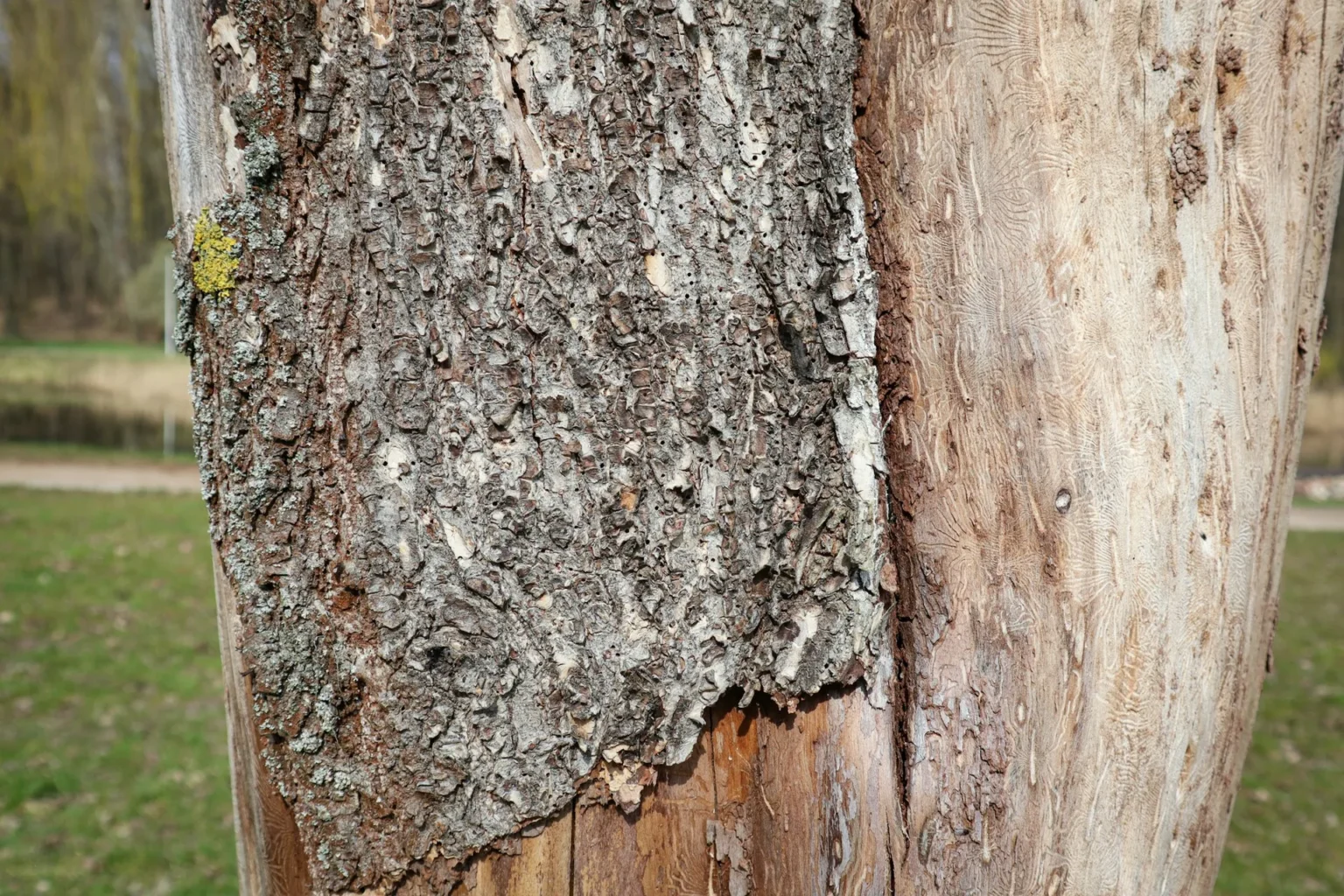
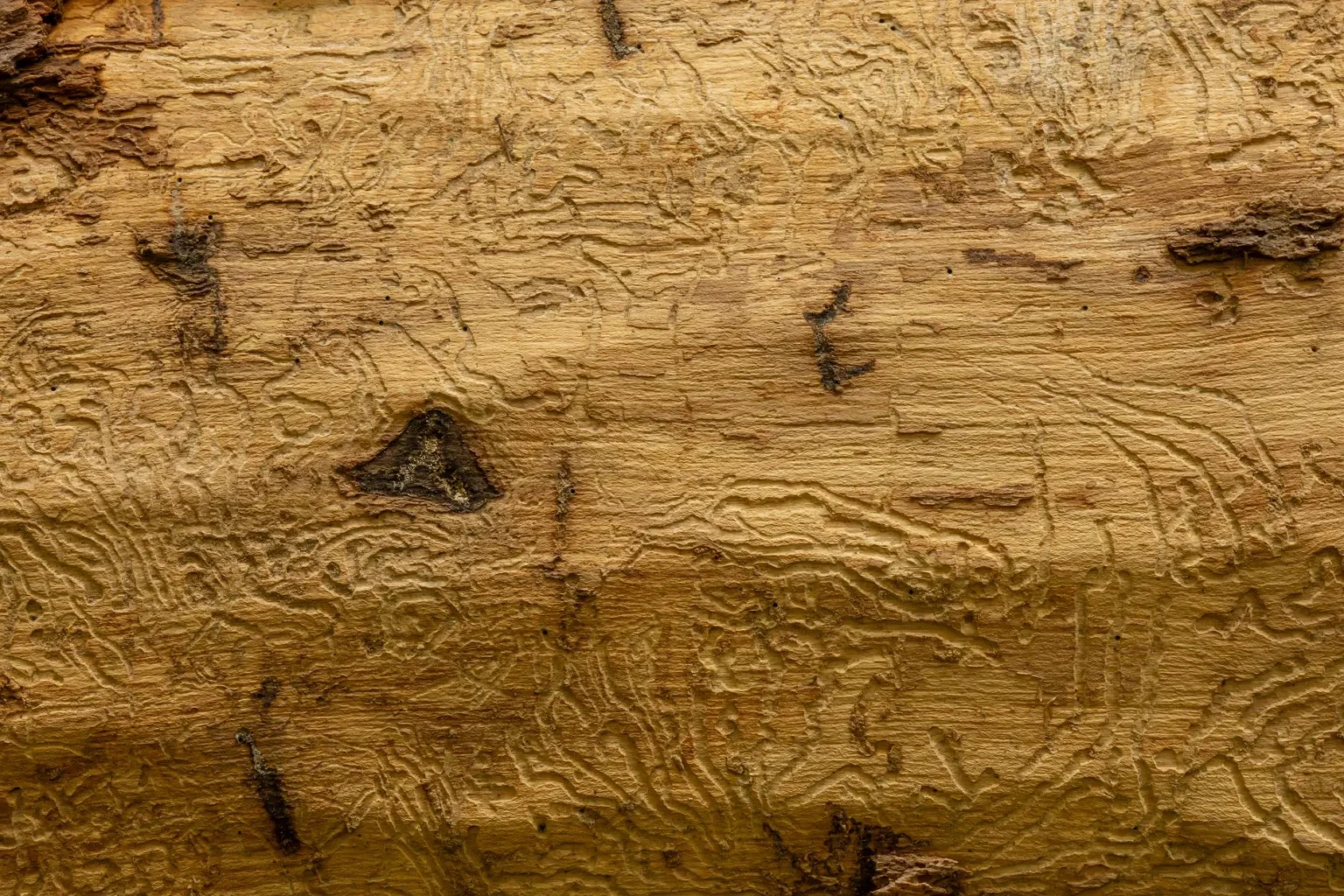
The publication says early symptoms can include dead branches near the top of a tree and wild, leafy shoots growing from the lower trunk. D shaped exit holes and bark splits that expose S shaped tunnels are described as significant signs, and woodpecker activity can also point to borers. Decline is usually gradual, which is why the document calls an infestation extremely difficult to confirm from a quick look.
The life cycle explains why November is a useful time to look. According to the publication, larvae tunnel under the bark and feed through the fall, and that tunneling and feeding is what eventually kills the tree. Larvae are dormant over the winter, and adults leave the tree in May through the exit hole. It adds that infested trees decline from the top down, and that cut and stacked ash wood more than one year old can still carry living larvae, which matters for firewood.
Not every ash with a thin crown has borers, and not every borer is the emerald ash borer. The ISA brochure on insect and disease problems sorts insects by how they feed, as chewing, sucking or boring insects, and says boring insects feed beneath the bark as larvae. Each group leaves a characteristic pattern of damage, and that pattern is part of how an arborist makes a diagnosis. A homeowner who sees tunnels or holes on a trunk should photograph them and call an arborist rather than guess.
Signs of borer activity on an ash tree
- Dead branches and thinning in the upper crown
- Leafy sprouts growing from the lower trunk
- Bark splits with tunnels visible underneath
- Small exit holes shaped like the letter D
A dead ash also becomes a hazard in its own right, because dead wood drops limbs in wind. Our storm proofing and repair work begins with a look at dead wood in the crown for that reason.
Pest or Stress: Reading the Crown and the Hillsdale Rules
The ISA brochure says an insect problem is generally secondary to a stress disorder or pathogen, and that stress can come from an improper balance of light and nutrients. It also warns that killing all insects without regard for their kind and function can be detrimental to tree health, and that treatment without confirming the issue is often ineffective. In plain terms, the first job is to find out what is wrong, and a spray is a poor way to find out.
The brochure gives a short method. Identify the tree, then compare it with others of the same species on the site. Non uniform damage may point to insects or disease, while uniform damage over a large area usually points to physical injury, poor drainage, chemical damage or weather. Roots tell a story too, since brown roots may indicate dry soil or toxic chemicals and black roots may indicate overly wet soil or root rot organisms.
The borough ordinance follows the same logic. It defines a hazard tree as one with an infectious disease or insect infestation, one that is dead or dying, or one that a certified arborist or Licensed Tree Expert finds to be a threat to public health, safety or welfare. It states that the chapter is not meant to restrict homeowners from removing dead, diseased or hazardous trees or from routine pruning.
The exemption still has steps. For a dead or substantially diseased tree, the owner applies to the Zoning Officer claiming the exemption, with photographs and a certification from a New Jersey Licensed Tree Expert, and the Zoning Officer inspects and verifies the condition. A tree that poses imminent danger to life or property may come down first, with the application filed within seven days afterward. The application also names a tree care business registered with the New Jersey Board of Tree Experts, and the board tells consumers to ask for the registration, proof of insurance and the license number of the licensed person.
What to note before calling about a sick tree
- The species of the tree and where it stands
- Whether damage is on one tree or many
- Photographs of the trunk, the crown and the soil
- Whether the tree is on your lot or the street
Street trees belong to the borough, and the ordinance sends removal requests to the Department of Public Works through the borough website. Once the cause is clear, ongoing care belongs in a plan, which is the idea behind our tree maintenance service.
Protecting Hillsdale Trees Through the Winter
Tree pest management in Hillsdale comes down to a few habits. Walk the property after leaf drop, look for egg masses and tunnels, separate pests from stress, and ask the borough before any removal that is not clearly exempt. Pests move between yards, so a short word with a neighbor about an egg mass or a dying ash can help protect more than one property. Our other local guides are in the Hillsdale tree care articles section.
We are family owned since 1960, and we will tell you plainly whether a tree needs treatment, pruning or removal. Our crews are ISA Certified Arborists and New Jersey Certified Tree Experts. Call Reliable Tree Service at (201) 943-4141 to schedule an inspection, or read more about our tree pest management services.
Related Articles

Tree Maintenance in Hasbrouck Heights NJ: Root Zones, Mulch, and Borough Rules
Hasbrouck Heights counts over mulching and root zone compaction as tree removal in its borough ordinance. This guide covers tree maintenance in Hasbrouck Heights, from the root radius and mulch depth to the yearly inspection.
Tree Trimming in River Vale NJ: Right of Way Limbs, Topping Rules, and Timing
River Vale now holds owners responsible for street trees next to their property, and a permit covers any limb six inches or more across. This guide covers tree trimming in River Vale, from the ordinance to the topping rule and timing.
Stump Grinding in Emerson NJ: Street Tree Permits, Root Rules, and Replanting
Emerson asks for borough approval before anyone cuts roots or removes soil near a street tree, and the stump is the last step of any removal. This guide covers stump grinding in Emerson, from permits and root rules to wood chips and replanting.
Tree Storm Proofing in Saddle Brook NJ: Hazard Trees, Root Zones and Township Rules
Saddle Brook defines a hazard tree in its written tree ordinance and leaves hazard trees free of fees and replacement duty. This guide covers defects to check once the leaves drop, root zone care and replacement rules.
Tree Removal in Dumont NJ: Borough Permit, $25 Fee, and Commission Inspection
Dumont requires a permit before any tree can be removed in the Borough, with a Shade Tree Commission inspection before work begins. This guide covers tree removal in Dumont, from the paperwork and fee to hazard signs, Borough owned trees and replanting.
Tree Pruning in South Hackensack NJ: Permits, the 25 Percent Limit, and Fall Timing
South Hackensack publishes a Shade Tree Commission permit form that covers pruning as well as removal, with a stated 25 percent limit. This guide covers tree pruning in South Hackensack, from the permit and fee to clean cuts and fall timing.