

Table of Contents
Tree Care in Teterboro, NJ
Teterboro is a small Bergen County borough with an unusual layout. According to Wikipedia it was incorporated on March 26, 1917, covers about 1.11 square miles, and counted 61 residents in the 2020 census. Teterboro Airport takes up a majority of the borough, and the rest is largely commercial. A storm damage inspection in Teterboro therefore often concerns trees beside parking lots, drive aisles, warehouses and the few homes.
This Thanksgiving brings two reasons to look closely. The National Weather Service office in Upton, New York, has issued a Wind Advisory that includes the Eastern Bergen County zone, where Teterboro sits, from 10 AM Thursday, November 26, to 5 AM Friday, November 27, 2026. It calls for northeast winds of 25 to 35 mph with gusts up to 55 mph, and it warns that tree limbs could be blown down and a few power outages may result.
The same office has a Coastal Flood Warning for Eastern Bergen from 7 AM Thursday to 6 AM Friday. It says flooding in vulnerable areas near the water will extend inland along tidal rivers, including the tidal portions of the Hackensack River. We read both alerts on Thanksgiving morning. Alerts change quickly, so check weather.gov for the latest wording. Neither alert reports damage in Teterboro.
Reliable Tree Service is family owned since 1960 and works across Hudson and Bergen counties from Cliffside Park. Our storm proofing and repair work looks at roots, trunks, unions and the crown, because wind and water stress all four at once.
Teterboro shares its weather with close neighbors. We recently wrote about dangerous tree notices in Moonachie and about wet soils and winter wind in Little Ferry. Future borough pieces will collect under our Teterboro tree care articles.
Storm Damage Inspection in Teterboro Starts With Water and Roots
Water is the part of this storm that is easy to underrate. The Coastal Flood Warning describes 1 and a half to 2 and a half feet of water above ground level in vulnerable areas near the waterfront and shoreline, with roads, parking lots, lawns and basements among the places that can be affected. It does not say that any particular Teterboro lot will flood. Drainage is local work here. The borough Public Works page lists sanitary sewer and drainage upkeep, along with catch basins and the Vincent Place pump station.
Drains and pumps can help water leave, but they are not a promise about a storm tide, so owners should still walk their ground once it is safe. Clearing leaves from a private grate before the rain is a simple step where it can be done safely. Standing water around a trunk matters because roots need air as much as they need moisture. Soil that stays full of water also grips roots less firmly than firm ground does, and that is the moment a gust has the most leverage on a large crown.
University of Minnesota Extension explains that water covering the soil reduces the supply of oxygen to roots, and that sediment left over the root area can do the same, with as little as three inches able to cause harm. It also notes that moving water can wash soil away from the base, leaving exposed roots that make a tree more vulnerable to being uprooted or broken by wind. Timing helps here. The same guide says trees are less likely to be damaged by flooding in the dormant season than during the growing season, though physical damage and soil loss can happen in any month.
A useful storm damage inspection in Teterboro starts at the ground, then moves up the trunk. Wait until the water has drained and the wind has settled. Never wade into floodwater to look at a tree, and keep clear of any area where wires are down. Take wide photographs first, so each trunk can be located later, then close views of the soil on every side. Note any tree standing close to pavement edges, ditches or drains, where water tends to linger.
Ground signs to check after the water drains
- Cracked or lifted soil on one side of a trunk
- Roots newly exposed where moving water washed soil away
- Silt or debris piled thickly over the root area
- A fresh lean that was not there last week
Edward Hufnagel, who owns Reliable Tree Service, puts it this way: “After wind and water, start at the ground. A tree can look fine up top while the soil around it is telling you something changed.”
Broken Limbs, Split Trunks and the Crown After High Wind
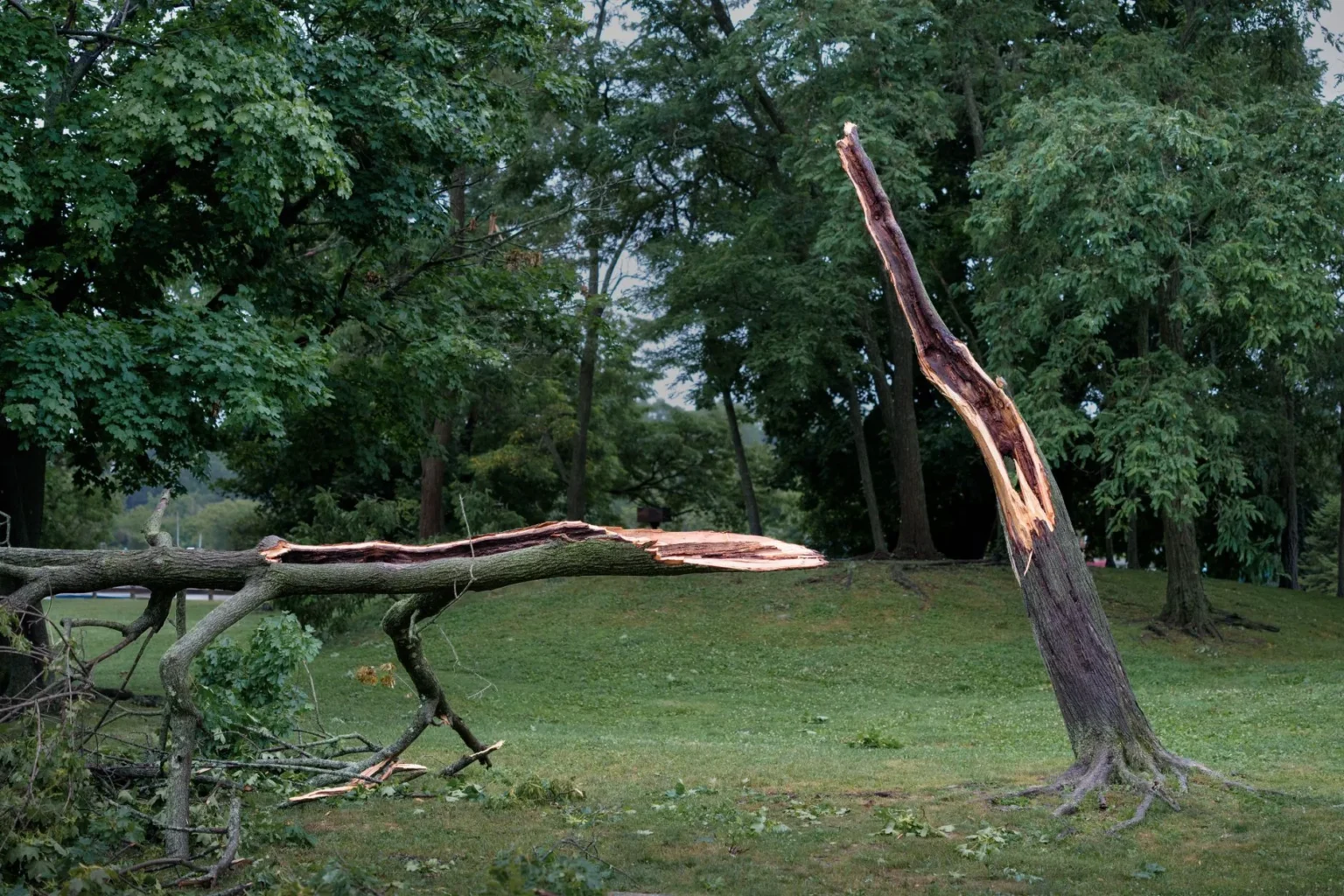
Once the ground has been read, look up. The International Society of Arboriculture says in its storm related tree damage brochure that strong winds can break branches and even uproot trees, particularly when combined with softened soil from heavy rain or snow. That combination is the one forecast for Thursday and Thursday night. The brochure also advises that an arborist check trees that seem undamaged, especially larger ones near people or property, for cracks, hanging branches and heaving soil.
The defects themselves are described in the society’s guide to recognizing tree risk. Codominant stems, two trunks of similar size that meet at one point, can often be failure points. Branches with their weight concentrated near the end are more prone to break. Cracks or splits along the trunk, major limbs or branch unions deserve prompt attention, and large dead branches are probably the most obvious hazard of all. The risk from a dead limb depends on its size and its distance from anything it could hit.
On a commercial property, those targets are easy to list. Think about employee parking, loading doors, walkways, fences, roofs and the vehicles that arrive before sunrise. A holiday weekend can leave a site quiet for several days, so a broken limb lodged overhead may go unnoticed until people return. Ask whoever opens the property first to walk the tree lines from a safe distance and to rope off any area under a hanging piece.
Keep the first visit to looking and photographing. Limbs under tension can move suddenly when cut, and anything near utility lines belongs to the power company and trained crews. Call the utility if a branch touches a wire. When the cleanup is ready to begin, our tree trimming and pruning crews remove torn and dead wood with clean cuts, and they check the remaining structure while they are in the crown.
Overhead damage to note from a safe distance
- Broken limbs still hanging in the upper crown
- Fresh splits where two large stems join
- Long branches now sagging toward doors or parked vehicles
- Loose bark or pale new wood on the trunk
Write down the location of each tree and what you saw, with the date and time. That short list lets an arborist put the most urgent trees first, and it gives an insurer or property manager a clear record of conditions right after the storm. Add a second set of pictures a week later, taken from the same spots, so any change in lean or soil is easy to compare.
Teterboro Tree Removal Rules to Check Before Cleanup
Cleanup in Teterboro also has to respect a local tree rule. The borough adopted Ordinance No. 643 on tree removal and replacement on March 12, 2024. Its opening explains that trees help manage stormwater, including erosion and infiltration, and that the borough wants to preserve its tree inventory while protecting the flight patterns of the airport. It is worth reading before any trunk comes down, and the current wording should be confirmed with the borough.
The rule applies by trunk size. Anyone planning to remove a street tree with a diameter at breast height of 2.5 inches or more, or another tree of 6 inches or more, submits a Tree Removal Application to the Borough Clerk, and removal waits for municipal approval. The ordinance sets a fee of $50 for each tree. Qualified removals call for one replacement tree for each tree removed, planted within twelve months and monitored for two years. Where replanting on the same property is not possible, the text allows another approved location or a $500 fee per replacement tree.
Storm damaged trees may fall under the hazard tree language. The ordinance includes a tree that is dead or dying, has an infectious disease or insect infestation, causes obvious damage to structures, or is judged a threat to public safety by a certified arborist or Licensed Tree Expert. Hazard trees may be removed with no fee or replacement requirement. Anyone claiming an exemption must give the Clerk written justification from a qualified tree expert or arborist, so arrange that statement before tree removal is scheduled.
The definition of removal is broader than cutting. It includes excessive pruning, toxic substances, improper mulching, and improper grading or soil compaction near the base when that leads to decline or death. Heavy equipment driven across soft, saturated ground can compact soil, so plan the route for any truck or loader. Responsible pruning and maintenance are expressly outside that definition. The penalty section sets a fine of $250 for each tree removed without a required replacement.
Records to gather before contacting the Borough Clerk
- Photographs showing the whole tree and the damage
- Trunk diameter measured four and a half feet up
- Location noted as street tree or private property
- Written findings from an arborist or tree expert
The ordinance also exempts removals made under certain government agencies, including federal aviation authorities. Ask the Clerk which path applies to your tree rather than assuming one. Keep copies of the application, the approval and the photographs together, because the replacement duty runs well past the day the wood is hauled away and someone may need to show what was agreed.
Protecting Teterboro Trees After the Thanksgiving Storm
The wind and high water of this holiday will pass, and some of their effects may show up later. A storm damage inspection in Teterboro is worth booking for any large tree near parking, doors or a home, even if it came through looking normal. Over the following seasons, watch for dieback in the crown, mushrooms near the base and new lean, and keep up regular tree maintenance so weak parts are found early.
Reliable Tree Service is family owned since 1960, and our team includes ISA Certified Arborists and New Jersey Certified Tree Experts. Call (201) 943-4141 about hanging limbs, split trunks or lifted soil, and ask about storm repair for damaged trees before the next system arrives.
Related Articles

Tree Storm Proofing in Rockleigh NJ: Thanksgiving Wind Prep for Wooded Lots
A Wind Advisory covers Bergen County and a High Wind Warning covers Hudson County from Thursday morning, and Rockleigh has plenty of tall trees to lose limbs. This guide covers tree storm proofing in Rockleigh before the wind arrives.

Tree Risk Evaluation in Washington Township NJ: Hazard Trees, Permits and Vendors
Washington Township in Bergen County has its own tree code, and it defines a hazard tree in plain terms. This guide covers tree risk evaluation in Washington Township, from the warning signs to the permit and vendor steps.

Tree Removal in Moonachie NJ: Dangerous Tree Notices and Public Right of Way Permits
Moonachie is a low lying Bergen County borough with its own rules for trees on public ground. This guide explains tree removal in Moonachie, from the borough code and dangerous tree notices to wet soils and curb debris rules.
Tree Storm Proofing in Little Ferry NJ: Wet Soils, Leaf Rules and Winter Wind
Little Ferry sits where the Hackensack River meets Overpeck Creek, and wet ground changes how trees hold in a storm. This guide covers tree storm proofing in Little Ferry, from root stress to borough leaf rules.
Tree Storm Cleanup in Carlstadt NJ: Brush Bundles, Yard Waste Days and Hazard Limbs
Carlstadt sets curb rules for yard waste, brush and wood scrap, and a storm can leave far more than the curb can take. This guide covers tree storm cleanup in Carlstadt, from bundles and bags to the hanging limbs that need a certified arborist.

Tree Trimming in Garfield NJ: Late Fall Pruning for Tight City Lots and Shade Trees
Tree trimming in Garfield means working with small lots, wires and mature shade trees in a dense Bergen County city. This guide covers when to prune, how much to take and how to avoid topping.