Table of Contents
Tree Care in Ridgefield Park, NJ
Storm repair in Ridgefield Park begins with the place itself. According to Wikipedia, Ridgefield Park was incorporated on June 15, 1892, as a village within Ridgefield Township, and it has used the Walsh Act commission form of government since 1912. The village covers 1.91 square miles in Bergen County, and about 10.8 percent of that area is water. It borders Teaneck, Hackensack, Leonia, and four other Bergen County towns, so its streets are short and close to neighboring trees and buildings.
Trees have a documented history here. The village Shade Tree Commission page says the commission was created in 1979 after residents voiced concern about the declining state of the street and park trees. Its first planting that year was ten trees, and the same page says Hurricane David destroyed 79 trees in less than 24 hours that year. That one storm took out several times what the new commission had planted.
Homeowners deal with the same problem on a smaller scale after every hard wind. A limb comes down, a trunk cracks, or a tree leans a little more than it did last week, and the first question is what to do next. This guide covers what a storm does to a tree, who handles what in the village, and how to judge damage before anyone picks up a saw.
Reliable Tree Service is family owned since 1960 and works across Hudson and Bergen counties from Cliffside Park. Our storm proofing and repair service covers both sides of a storm, the preparation before it and the repair after it. This guide is general information, and you should confirm current rules with the village before any work starts.
Fall is a practical time to look at tree damage. Leaves are still on many trees, which adds weight and wind load to any weak branch, and the ground is often wet. Our Ridgefield Park tree care guides collect what we publish for the village, and the same habits apply in nearby towns such as Teaneck, where we wrote about fall tree storm proofing.
What a Storm Does to a Tree and What to Do First
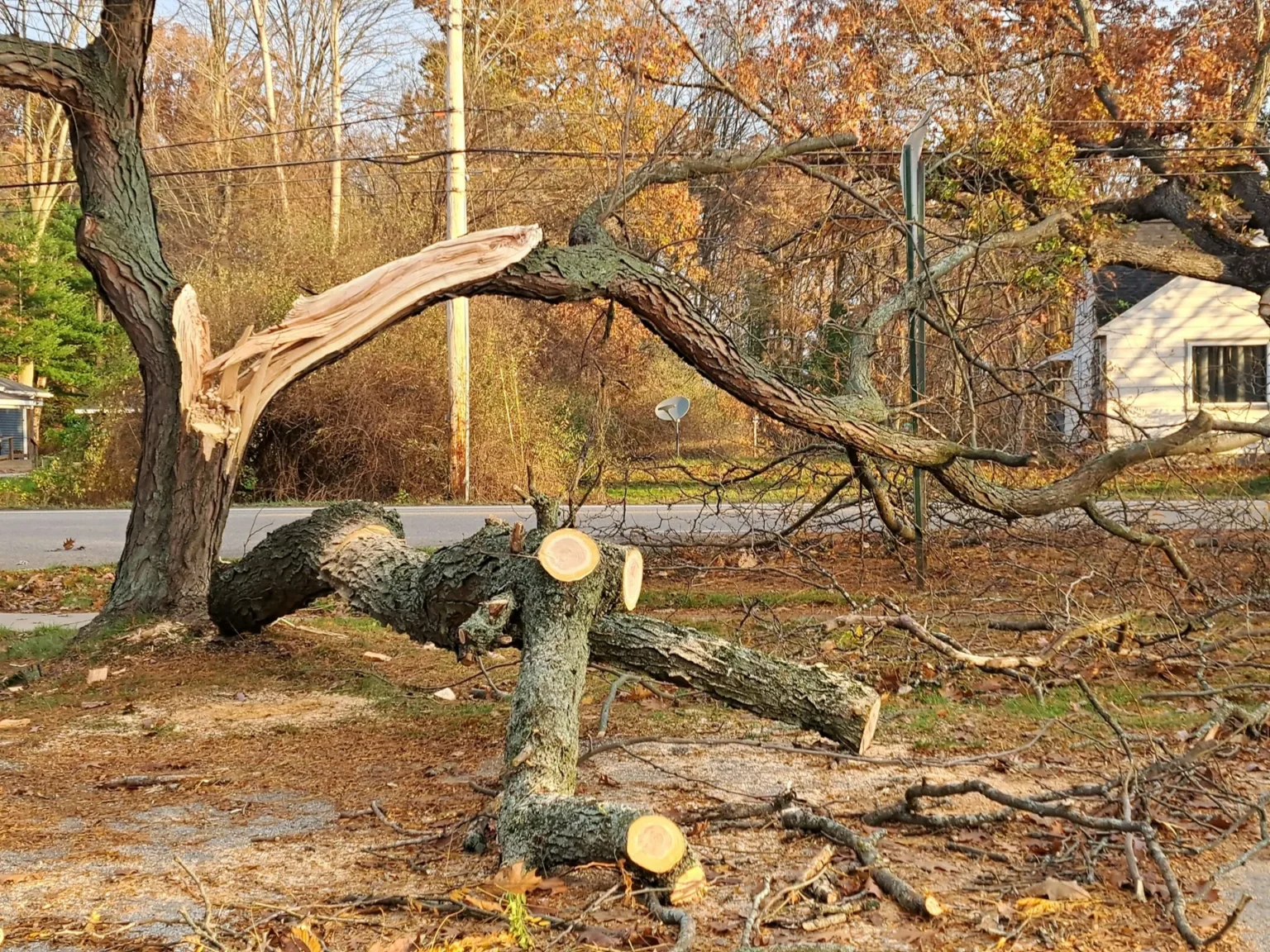
The International Society of Arboriculture describes three ways a storm hurts a tree in its storm related tree damage brochure. Strong winds can break branches and even uproot a tree, particularly when heavy rain has softened the soil. Heavy snow or ice can snap limbs under the added weight, and lightning can rupture wood and loosen bark. Each leaves a different kind of damage, and each needs a different kind of look.
The first job after a storm is safety, and the same brochure lists the hazards. Broken limbs hanging overhead and fallen trees resting in other trees or on roofs can keep moving after the weather has passed. Trees and limbs under tension may react unexpectedly when cut or moved. A damaged tree may also touch electrical wires, directly or indirectly, and removing anything near a power line takes training and equipment.
The brochure also tells homeowners to resist the urge to do the cleanup themselves. Working at height, retrieving tree parts from a roof or a service line, and running cutting equipment are all inherently dangerous, and debris cleanup is included in that warning. That is why we ask owners to wait for an inspection. A tree on the ground can wait a few days, while a hurt homeowner cannot.
The assessment should reach past the tree that fell. ISA says an arborist should also check trees that seem undamaged, particularly larger trees near people or property, for cracks in trunks or limbs, hanging branches, and soil heaving. That second look is where storm repair in Ridgefield Park often finds the next problem before the next storm does.
Storm repair in Ridgefield Park: first steps after a storm
- Stay clear of hanging limbs and leaning trunks
- Treat any contact with wires as a utility emergency
- Photograph the damage from a safe distance
- Call an arborist before starting any cleanup
Photographs help when you talk to an insurer, and they help the arborist see what changed. Our storm proofing and repair visits start from the photos and then move to the tree itself.
Edward Hufnagel, who owns Reliable Tree Service, puts it this way: “A broken limb is just the part you can see from the street. What matters is where it tore away from the tree and what the wood looks like when you get close.”
Village Rules for Damaged and Hazard Trees
Ridgefield Park treats its public trees as a managed resource. The village Shade Tree Commission, created by ordinance in 1979 after a year of research by an advisory board, is a volunteer body. Its page says it manages all public shade trees on streets and in parks, plans strategic planting, removes dead or hazardous trees, surveys and assesses village trees, and has hosted tree planting events every Arbor Day since 1982.
That matters after a storm because a street tree and a yard tree can sit a few feet apart and belong to different owners. A limb over a village street or park usually points to the commission and the village, while a tree in your own yard is yours to manage. The commission page lists a sidewalk repair program as temporarily paused effective May 1, 2026, with approved repairs still to be completed, so check its status before counting on it.
Removal has its own rules. The village page on the tree removal and replacement ordinance says a permit may be required for street trees with a trunk diameter of 2.5 inches or more and for trees on private property with a trunk diameter of 6 inches or more. The application fee is listed as $50 for the first tree and $25 for each additional tree removed at the same time. Applications go to the Tree Enforcement Officer, and larger trees that come out must be replaced based on their size.
The same page lists exemptions, including hazard trees approved in advance. Decisions can be appealed to the Shade Tree Commission within 10 days. A written assessment of the damage from a certified arborist gives you something concrete to show the village, and it is worth asking about the approval before any cutting begins. Rules and fees change, so confirm the current ordinance and the full text with the village.
Questions to settle before any cut
- Whether the tree counts as a street tree
- Trunk diameter measured at breast height
- Whether the hazard needs approval in advance
- How replacement will be handled if required
Our tree removal services include this paperwork conversation, since a permit settled early costs far less than a stopped job. The village Shade Tree Commission meets on the fourth Monday of each month at 7:00 p.m. in the Municipal Building, according to its page.
Repair, Cable, or Remove: Reading the Damage
Not every damaged tree needs to come down. ISA notes in its recognizing tree risk brochure that there is no such thing as a completely safe tree, and that judging how serious a defect is falls to a professional arborist. The arborist may suggest pruning, cabling and bracing, routine care, or removal. A broken limb with a clean tear and a sound trunk is often a pruning job, while a split at the main union is a different conversation.
The brochure lists what to look for. Codominant stems, which look like a split trunk, can be failure points. Cracks or separations in the soil can mean soil heaving from excessive root movement, a warning sign especially when the tree leans. Large dead branches, hanging branches, loose bark, cavities, rotten wood, and mushrooms at the base all raise the question of risk. A tree that was topped or heavily pruned in the past belongs on the list as well.
Local guidance points the same way. The village sheet on selecting an arborist, linked from its Shade Tree Commission page, says removal should be a last resort and warns about anyone eager to take down a living tree. It says arborists will recommend topping only in rare cases, such as saving a tree after severe damage to the crown, and that a careful arborist will not use climbing spikes on a tree that is staying. We agree, and we would rather save a sound tree with careful cuts or a support cable than remove it.
Repair is slower than removal, which is part of why it is worth doing well. A torn branch stub is pruned back to a proper cut so the tree can close the wound, and a weak union may be supported with a cable rather than left to fail again. Storm repair in Ridgefield Park is as much about the next five seasons as the next five minutes. When a tree cannot be made safe near a house, removal is the honest answer, and we say so.
Signs a damaged tree needs more than cleanup
- Cracks or splits at the main branch union
- Soil cracks or lifting on one side of the trunk
- Large hanging limbs over a roof or driveway
- Fresh lean in a tree that stood straight
Our tree trimming and pruning crews handle the repair cuts, and the same inspection tells us whether the tree should stay or go. The tree maintenance visits afterward keep an eye on how a repaired tree is healing.
Protecting Ridgefield Park Trees Before the Next Storm
The best time to learn what your trees can take is before the next storm. A walk around the yard in fall, looking up for dead wood and down for soil that has lifted, takes an hour and tells you what to watch. Ridgefield Park has Overpeck County Park beside it, and the Bergen County parks page notes that Ridgefield Park is one of five towns that donated land around Overpeck Creek, a reminder that open ground and mature trees are part of daily life here.
If a storm does damage a tree, call a professional before you pick up a saw. The village sheet warns that door knockers are especially common after storms, and it advises asking for certificates of insurance, never letting yourself be rushed by bargains, and never paying in advance. ISA says much the same in its Why Hire an Arborist brochure, including checking for an ISA credential and getting the agreement in writing. Our own guide to choosing an arborist covers the questions to ask.
Our crews are ISA Certified Arborists and New Jersey Certified Tree Experts, and Reliable Tree Service is family owned since 1960. Call us at (201) 943-4141 to schedule a storm repair visit or a fall inspection in Ridgefield Park. We will tell you plainly what is sound, what needs repair, and what should wait.
Related Articles

Tree Trimming in Glen Rock NJ: Pruning Before Removal Under the Borough Tree Permit
Glen Rock has held Tree City USA status since 1990 and now requires a permit to remove many private trees. This guide covers tree trimming in Glen Rock, from good pruning cuts to the rules that apply when a tree might come down.
Tree Removal in Edgewater NJ: Permits, Hazard Trees, and Replacement Planting
Edgewater asks for a borough application before many trees come down, and its ordinance treats hazard trees differently. This guide covers the permit steps, warning signs of a failing tree, and what replacement planting requires.
Land Clearing in Oakland NJ: Tree Permits, Root Zones, and Fall Planning
Oakland’s tree ordinance treats clearing a wooded lot differently from removing a single tree, and the roots left behind decide how the lot ages. This guide covers borough permits, root protection, and fall planning for wooded properties.
Tree Pest Management in Harrison NJ: Spotted Lanternfly and Tree of Heaven in Fall
Spotted lanternflies lay eggs in October and tree of heaven draws them in, so fall is the time to look closely. This guide covers tree pest management in Harrison from the first signs to what to do about egg masses.
Tree Feeding in Rutherford NJ: When Fall Fertilizing Helps Mature Shade Trees
A tree that looks tired is not always hungry, and fertilizer at the wrong time can do harm. This guide covers tree feeding in Rutherford from soil testing to timing and placement.
Stump Grinding in Kearny NJ: What to Know After a Tree Comes Down
A stump is a piece of the ground, and in Kearny the town rules, utility marks, and soil all affect what happens next. This guide covers stump grinding in Kearny from approval to replanting.