Table of Contents
Tree Care in Ramsey, NJ
Ramsey is a Bergen County borough about 26 miles northwest of Midtown Manhattan, and according to Wikipedia it was incorporated on March 10, 1908, from portions of Hohokus Township. The same page lists about 153 acres protected under Green Acres and small lakes such as Suraci Pond on Woodland Avenue. That much open ground carries a lot of mature trees, which makes tree storm proofing in Ramsey a practical question for homeowners and not a theoretical one.
Those trees have been tested recently. The National Weather Service office in New York publishes local storm reports for the region, and its page for June 12, 2026 lists thunderstorm wind damage across Bergen County. One entry, logged at 6:20 PM from the fire department, reports a tree down onto a home on Forest Avenue near Ramsey. Another, twenty minutes later, reports several trees down across Hackensack.
Reliable Tree Service has been family owned since 1960 and works across Hudson and Bergen counties out of Cliffside Park. This guide explains how storms break trees, who is responsible for which trees in Ramsey, and what a homeowner can check this fall, with the borough’s own pages linked so you can confirm every rule yourself.
Fall is a good time to look, even though the worst of thunderstorm season has passed. As leaves drop, dead limbs, cracks, and crowded branch unions show up against the sky in a way they do not in July. The soil is also usually moist this time of year, and the International Society of Arboriculture notes that strong winds can uproot trees, particularly when they combine with soil softened by heavy rain or snow.
Storm proofing is not one big job. It is a handful of small decisions made on a calm day, such as which limb to remove, which union to support, and which tree needs a closer look. Our storm proofing and repair work follows that order, and our other Ramsey tree care guides are collected on one page.
What a Thunderstorm Does to Mature Trees in Ramsey
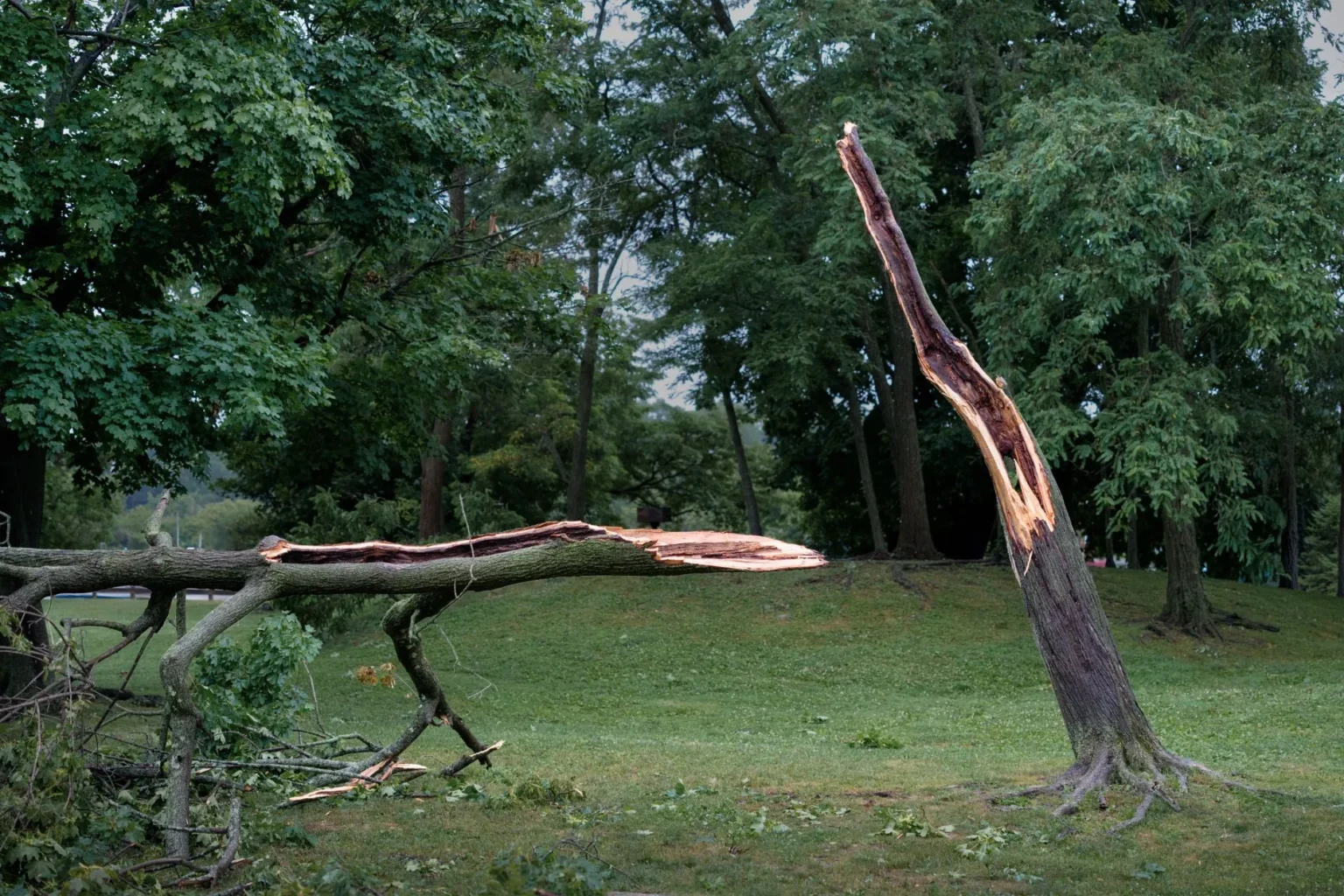
The ISA brochure on storm damage to trees names three common ways a storm hurts a tree. Strong winds can break branches and even uproot a whole tree. Heavy snow or ice loads can snap limbs under the added weight. Lightning heats the water inside the wood so fast that the wood ruptures and bark can come off the trunk. A thunderstorm in Ramsey usually brings the first of these, wind, along with a soaked root zone.
A tree in full leaf catches far more wind than the same tree bare, which is why a summer thunderstorm can break limbs that a winter gale leaves alone. The wood that fails first is rarely healthy wood. It is the dead branch, the cracked union, or the stem that was already carrying more than its share of the crown.
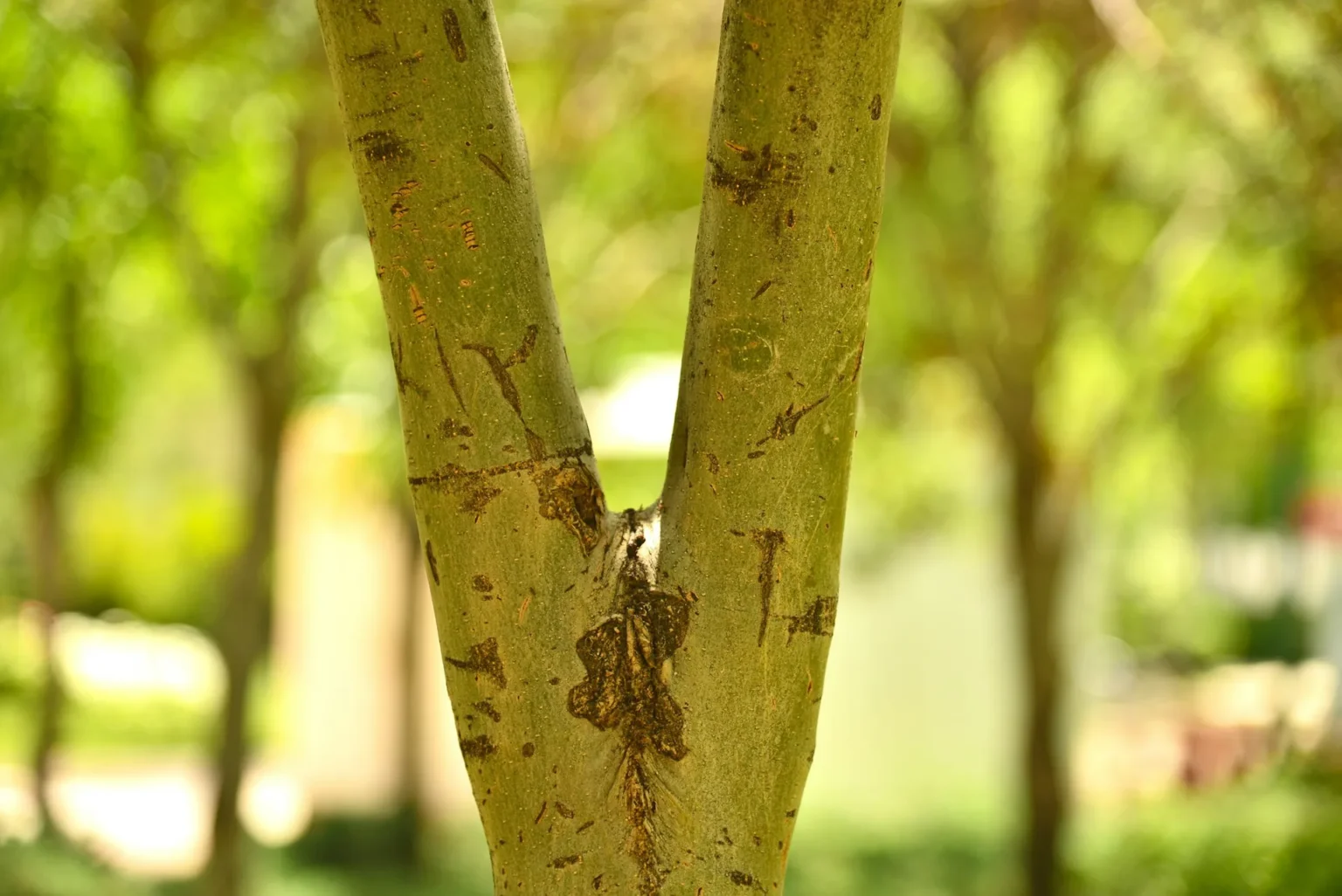
The ISA Recognizing Tree Risk brochure lists the defects to look for. Among them are codominant stems, which are two stems of similar size that grow from one point and can become failure points, and cracks or splits along a trunk or at a branch union. It also lists root failure, where cracks or gaps in the soil point to soil heaving, which is a warning sign especially if the tree leans. The photograph above shows the first pattern, a trunk dividing into two stems of about equal size.
Dead branches are the most obvious hazard of all. The brochure says the risk from a dead limb depends on its size and its distance from anything that could be hit, so a small dead twig over a lawn is a different matter from a large dead limb over a bedroom roof. A defect is not a verdict, and many trees with defects stand safely for years, but a defect over a target deserves a professional opinion.
Defects to check before the next storm
- Two stems of equal size joined at a narrow fork
- Cracks or splits along a trunk or branch union
- Soil heaving or gaps at the base of a leaning tree
- Large dead branches hanging over a roof or driveway
Any one of these is worth a closer look when you plan tree storm proofing in Ramsey, and a combination is worth a call. A tree maintenance visit gives an ISA Certified Arborist the chance to judge which defects matter on your lot and which can simply be watched.
Edward Hufnagel, who owns Reliable Tree Service, puts it this way: “A storm does not make a tree weak. It finds the weakness that was already there, so the time to look is on a calm day, at the places where a trunk or a limb joins.”
Borough Trees, Private Trees, and the Removal Rule in Ramsey
The first question on any Ramsey property is whose tree it is. The borough’s Shade Tree Department page says trees in the borough right of way, usually the first 10 feet from the curb line, are borough trees, and so are all trees on municipal properties. Any work on a borough tree, including trimming or removal, needs Shade Tree Commission approval first.
The Shade Tree Commission page describes the commission as the group that oversees planting, removal limits and permits, and questions about right of way trees. It adds that the borough trims and removes borough trees while the county handles trees in the county right of way. The commission meets at 7:30 p.m. on the third Thursday of each month, and its agendas and minutes are posted on the same page.
A tree on a private lot is the owner’s to care for. The borough does ask for a tree removal permit before more than six trees over 4 inches in diameter, measured 4 feet above the ground, come off a private lot within any 12 months. The department page cites Ordinance Number 30-2000, says violations carry fines, and links an application form, but it does not list fees or processing times, so call the borough before you schedule the work.
One damaged tree falls well under that limit, but storm preparation sometimes involves several trees on a larger lot. Counting them in advance keeps you on the right side of the rule. The commission page also says a tree care business must be registered with the New Jersey Board of Tree Experts and train its employees in safe equipment operation, and it points residents to njtreeexperts.org to check a registration. Our tree removal crews work inside that framework.
Questions to settle before any tree comes down
- Whether the tree stands on the lot or in the borough right of way
- Whether the planned work crosses the limit that needs a permit
- Whether the company is registered with the state tree board
- Whether a replacement tree belongs in the plan
Written answers to those four points keep the owner, the borough, and the tree on the same page. If a limb from a borough tree is hanging over your property after a storm, report it to the commission rather than cutting it yourself, since the work on that tree is the borough’s to approve.
Fall Storm Proofing for Ramsey Yards: Roots, Limbs, and Roofs
Limbs over roofs are the first thing we look at. A large limb that reaches over a house or garage is a target and a hazard in one, and the ISA risk brochure is blunt about trees near utility lines. It says never to attempt to remove branches or any tree part from or near power lines, and never to go near downed power lines, since they could still be conducting electricity. If tree parts touch a utility line, call the electric provider.
The ground under a tree matters as much as the crown. The brochure lists human caused defects such as wounds, root loss, and decay that follow construction, grade changes, soil compaction, or poor pruning. The borough’s department page adds a plain warning that weed whackers and lawn mowers can damage trees, and that young trees can be severely harmed or killed if their bark is torn. A mulched bed around each tree keeps equipment away from the trunk.
Ash trees deserve a separate look. The commission page says emerald ash borer has been identified in New Jersey and in Ramsey, and it lists the signs, which are canopy dieback, yellowing or browning leaves, and D shaped exit holes in the bark. Dead wood is the first to fail in a storm, so a declining ash near a house is both a pest problem and a storm problem. Our tree pest management page explains how we approach the pest side.
When an arborist finds a defect, the ISA brochure lists the usual answers. They are pruning to remove defective branches, cabling and bracing to support weak stems, routine care such as mulch and water, and removal when the risk is too high. It adds that supports are not guarantees against failure. Careful tree trimming and pruning comes first in most cases, because it is the smallest step that reduces the load.
Steps for tree storm proofing in Ramsey this fall
- Walk the yard and note dead or hanging limbs
- Photograph cracks, leans, and fungus at the base
- Book an inspection before the next wet, windy forecast
- Keep leaf piles clear of storm drains and hydrants
The last step comes from the borough itself. Its leaf collection notice of September 25, 2026 asks residents to put out loose leaves only, at the curb or edge of the sidewalk, and not to cover storm water inlets or fire hydrants. Bagged leaves are not accepted. A clear inlet is one less place for heavy rain to back up on your street.
Protecting Ramsey Trees Before the Next Storm
Storms in Ramsey will keep arriving, and tree storm proofing in Ramsey works best when it starts early, since most of the damage that follows starts with a defect that could be seen on a calm day. A short walk around the yard now, with the leaves coming down, costs nothing and gives you a list of questions for an arborist. Neighbors in other towns have asked the same questions, and our guides to storm repair in Ridgefield Park and storm proofing in Teaneck cover the same ground.
Our crews are ISA Certified Arborists and New Jersey Certified Tree Experts. If a tree on your lot has a crack, a lean that is new, or a large dead limb over the roof, ask for an inspection and we will walk the property with you. The visit ends with plain answers in order of urgency, and some trees need nothing more than a watchful eye.
Call Reliable Tree Service at (201) 943-4141 to schedule an inspection in Ramsey. We are family owned since 1960, and we will explain what each defect means before any work begins.
Related Articles

Tree Removal in Park Ridge NJ: Hazard Trees, Replacement Rules, and Root Zones
Park Ridge adopted a tree removal and replacement ordinance in 2024, and it reaches further than most owners expect. This guide covers tree removal in Park Ridge, from hazard trees to replacement planting and the root zone.
Tree Maintenance in River Edge NJ: Leaves, Mulch, and Root Care for Fall
River Edge has been a Tree City USA every year since 2000, and what happens on the ground under a tree matters as much as what happens in the canopy. This guide covers tree maintenance in River Edge from fallen leaves and mulch to who handles street trees.
Tree Removal in North Bergen NJ: Hillside Roots, Hazard Trees, and Replacement Rules
North Bergen sits on the Hudson Palisades, so trees grow on steep ground, close to walls and buildings. This guide covers tree removal in North Bergen, from what a slope does to roots to the paperwork worth gathering first.
Tree Trimming in Fairview NJ: Borough Tree Rules, Wires, and Small Lot Pruning
Fairview is a Bergen County borough with a written tree code, small lots and mature trees close to buildings and wires. This guide covers tree trimming in Fairview, from what the borough code regulates to when and how to prune.
Tree Pest Management in Oradell NJ: Ash Trees, Emerald Ash Borer, and Borough Rules
Oradell is a Bergen County borough with a written tree code and a lot of mature shade trees, and some of them are ash. This guide covers tree pest management in Oradell, from the signs of emerald ash borer to the borough approvals that apply before any cutting.
Tree Maintenance in Closter NJ: Street Tree Rules, Root Protection, and Fall Care
Closter has a Shade Tree Commission that controls street trees and a private property code that counts root damage as tree removal. This guide covers tree maintenance in Closter, from who may touch which tree to a fall walk around mature trees.